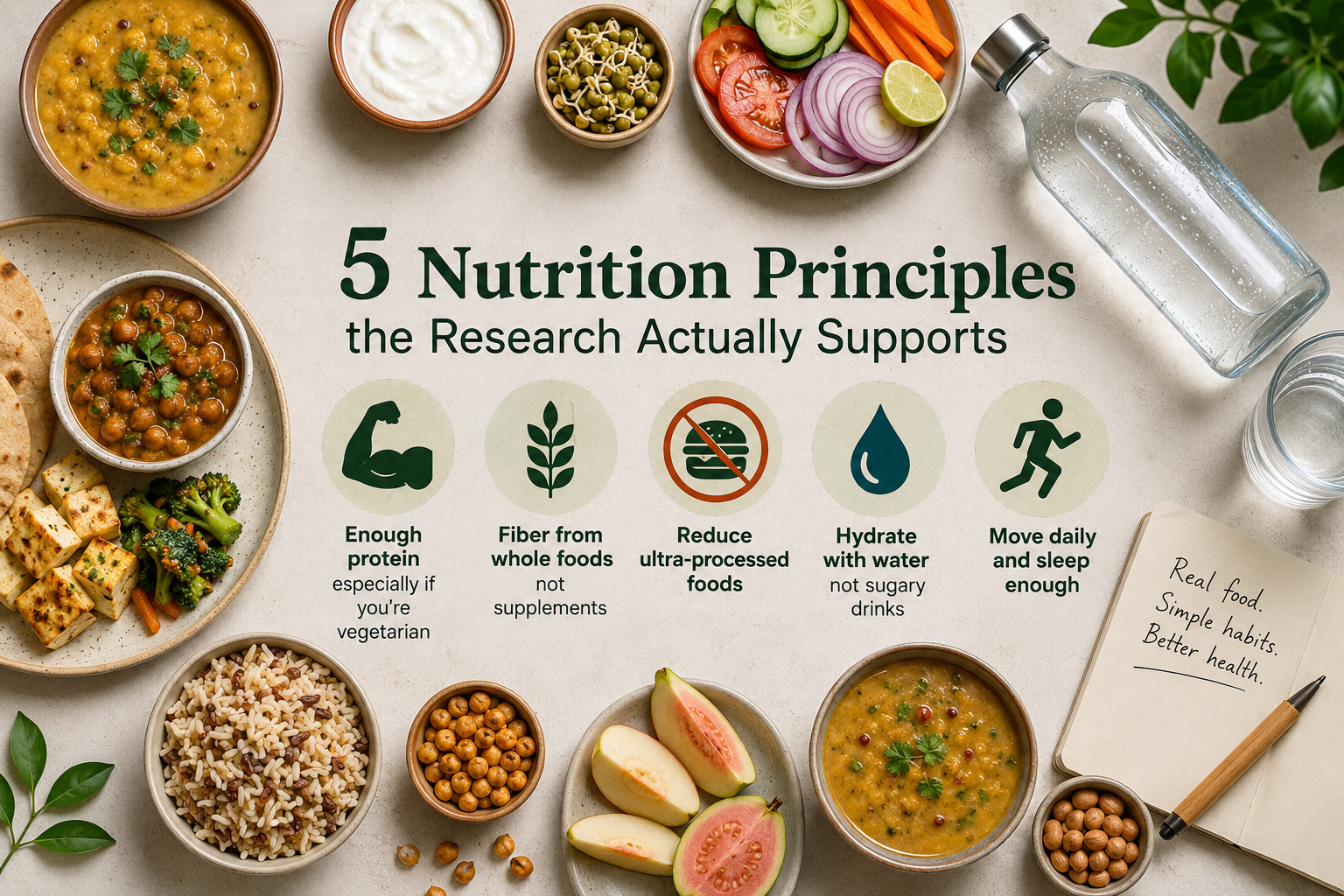
5 Nutrition Principles That Actually Matter (And 3 Trends Worth a Closer Look)
Most of the nutrition advice that fills WhatsApp forwards, Instagram reels, and well-meaning aunties’ speeches is noise. Some of it is wrong. Some of it is right but irrelevant. Some of it is right and important — but those parts get drowned out by the louder, trendier claims.
This guide cuts to what mainstream nutrition research actually supports for healthy adults in India, and what gets more attention than the evidence warrants.
At a glance
What matters most (each backed by major nutrition bodies — ICMR, WHO, Harvard School of Public Health):
- Enough protein, especially if you’re vegetarian
- Fiber from whole foods, not supplements
- Reduce ultra-processed foods
- Hydrate with water, not sugary drinks
- Move daily and sleep enough
Three observations on popular nutrition trends — where the popular narrative tends to outpace the evidence:
- Meal timing and intermittent fasting
- “Superfoods” and trendy imported ingredients
- Most supplements (with a few real exceptions)
How we evaluated
For each principle, we checked the position of established nutrition bodies (the Indian Council of Medical Research, the World Health Organization, the Harvard T.H. Chan School of Public Health, and the US Preventive Services Task Force) and the most-cited recent research on the topic. Where claims are well-supported, we state them plainly. Where they are contested or evolving, we say so.
We avoided diet-book authors, wellness influencers, supplement companies, and trendy “biohacking” sources. None of those funded or contributed to this article. See our Editorial Policy for full standards.
5 nutrition principles the research actually supports
1. Get enough protein — especially if you’re vegetarian
What the research says: Adequate protein intake supports muscle maintenance, blood sugar control, satiety after meals, and healthy aging. The Indian Council of Medical Research’s 2024 Dietary Guidelines recommend roughly 0.83 grams of protein per kilogram of body weight per day for healthy adults — about 50 grams for a 60 kg adult. Active people and older adults benefit from more (up to 1.2–1.6 g/kg).
Why most Indians get this wrong: Vegetarian Indian diets often centre on rice and roti, which are dominated by carbohydrates. Without deliberate protein additions — dal, paneer, eggs, dairy, soya, fish, chicken — many adults end up under the recommended intake. The 2016–17 ICMR Comprehensive National Nutrition Survey found that protein inadequacy was widespread, particularly among women and lower-income households.
How to apply this: Include a protein source at every meal. Realistic Indian examples:
- Breakfast: paneer or eggs or moong dal chilla
- Lunch: dal + sabzi + roti or rice
- Dinner: chicken/fish/paneer/tofu + vegetables
- Snacks: roasted chana, peanuts, yogurt, sprouts
2. Eat fiber from whole foods — not supplements
What the research says: Fiber supports gut health, lowers cholesterol, helps blood sugar control, and increases satiety. The ICMR recommends 40 grams of fiber per day for Indian adults. Most studies estimate average Indian intake is closer to 15–20 grams — about half.
Why most Indians get this wrong: White rice and refined wheat (maida) dominate urban Indian diets. Most packaged “high-fiber” foods (biscuits, breakfast cereals) add isolated fiber to ultra-processed bases — which research suggests is not nutritionally equivalent to fiber from whole foods.
How to apply this: Pick whole foods over supplements.
- Switch some meals to brown rice, millets (jowar, bajra, ragi), or whole wheat instead of white rice and maida
- Eat fruit with the skin (apples, pears, guava) instead of juice
- Add raw vegetables to meals — salads, kachumber, sprouts
- Include legumes (dal, chana, rajma) regularly
Fiber supplements (psyllium husk, etc.) have a place if dietary intake genuinely cannot be improved — but they don’t replace the benefits of fiber-rich whole foods.
3. Reduce ultra-processed foods
What the research says: Ultra-processed foods (UPFs) — defined under the NOVA classification as industrial formulations containing additives, refined ingredients, and substances not found in home kitchens — are linked to higher calorie intake, weight gain, and increased disease risk in multiple large studies.
The landmark research: a 2019 randomized controlled trial by Hall et al. in Cell Metabolism had 20 adults eat either ultra-processed or unprocessed diets matched for calories, sugar, fat, and fiber. On the ultra-processed diet, participants ate about 500 extra calories per day and gained weight. They lost the weight when switched back to the unprocessed diet.
Why most Indians get this wrong: UPFs in India include packaged biscuits, namkeen, instant noodles, ready-to-eat meals, sweetened breakfast cereals, packaged fruit juices, and many “health” snacks marketed as nutritious. Marketing claims like “made with whole grain” or “no added sugar” don’t change the classification.
How to apply this: Use a simple test — if the ingredient list contains things you wouldn’t keep in your home kitchen (emulsifiers, flavour enhancers, hydrogenated oils, modified starches, multiple food colours), it’s likely ultra-processed. The fewer items on the label, the better.
This does not mean never eating any processed food. It means making them the exception, not the everyday default.
4. Hydrate with water — not sugary drinks
What the research says: Sugar-sweetened beverages — including sodas, packaged fruit juices, sweet lassis, and most “energy drinks” — are linked to higher rates of obesity, type 2 diabetes, and cardiovascular disease in extensive observational research. The WHO recommends limiting added sugar to less than 10% of daily energy intake (about 50 g for a typical adult), with further benefits below 5% (25 g).
Why most Indians get this wrong: A single 250 ml glass of packaged fruit juice often contains 20–25 g of sugar — close to a full day’s limit. Aerated drinks have 35–45 g per 330 ml can. “Healthy” packaged drinks (flavoured yogurt drinks, sweetened lassi, fruit smoothies) often have similar sugar loads.
How to apply this: Make water the default beverage. For variety:
- Nimbu pani without sugar (or with a small amount)
- Buttermilk (chaas)
- Herbal teas and plain green tea
- Coconut water (whole, not packaged)
- Coffee and tea without (or with less) sugar
Whole fruit is preferable to fruit juice — the fiber slows sugar absorption.
5. Move daily and sleep enough — these are nutrition-adjacent
What the research says: Physical activity and sleep are not strictly nutrition, but they substantially affect how your body uses food. The WHO’s 2020 physical activity guidelines recommend at least 150–300 minutes of moderate-intensity activity per week (about 30 minutes a day, most days) for adults. Sleep durations of less than 6–7 hours are repeatedly associated with increased weight gain, insulin resistance, and altered hunger hormones (ghrelin and leptin) in clinical research.
Why most Indians get this wrong: Urban Indian lifestyles are increasingly sedentary — long commutes, desk jobs, evening screens, late dinners, short sleep. No amount of careful eating fully compensates for chronic inactivity and sleep deprivation.
How to apply this: The most effective changes are also the simplest:
- A 30-minute walk daily — break it into 3 × 10 minutes if needed
- Take the stairs when reasonable
- Consistent sleep schedule, aiming for 7+ hours
- Last meal at least 2–3 hours before sleep
- Reduce screens 30 minutes before bed
You do not need a gym membership or a fitness tracker for any of this.
3 observations on popular nutrition trends
These are three areas where the popular narrative tends to outpace the evidence. They aren’t necessarily harmful — some have real but narrower benefits than the hype suggests. Worth understanding before adopting them as habits.
1. Meal timing and intermittent fasting
The hype: Intermittent fasting (IF) — 16:8 eating windows, OMAD (one meal a day), alternate-day fasting — is presented as a metabolic upgrade beyond simple calorie reduction.
What the research actually says: A 2022 randomized controlled trial in NEJM (Liu et al., n=139) directly compared time-restricted eating (8-hour window) with plain daily calorie restriction in patients with obesity. After 12 months, both groups lost similar amounts of weight (~8 kg) with no meaningful difference in body composition or metabolic markers. When calories are matched, IF does not outperform other approaches.
What this means in practice: IF can work as a weight-loss tool — but mainly because it acts as a built-in calorie limiter for people who otherwise struggle with portion control. It is not a metabolic shortcut, does not “switch on” fat-burning hormones in a unique way, and does not prevent disease beyond what equivalent calorie reduction would do.
A useful distinction between protocols:
- 12–14 hour overnight fast (e.g., dinner by 8 pm, breakfast by 8–10 am): reasonable for most healthy adults, easy to sustain, avoids late-night eating.
- 16:8 daily eating window: can work if it naturally reduces calorie intake and doesn’t lead to overeating during the eating window. Not magic.
- More aggressive protocols (18:6, OMAD, alternate-day fasting): not clearly justified by the evidence as universally superior. May work for some; harder to sustain.
Who should be cautious: people taking diabetes medications (insulin, sulfonylureas) or blood pressure medications, pregnant women, those with a history of disordered eating, people with low blood pressure, migraines, hormonal imbalances, or significant medical conditions. Aggressive fasting in these populations should only happen under medical supervision.
2. “Superfoods” and trendy imported ingredients
The hype: Quinoa, chia, kale, goji berries, açaí, matcha, and many others are marketed as nutritionally superior to traditional foods. Many cost 5–10× more per gram than equivalent local options.
What the research actually says: Most “superfood” claims are based on extrapolations from cell or animal studies, or on single nutrients present in modest amounts. No major nutrition body (ICMR, WHO, Harvard SPH) recognises “superfoods” as a meaningful category. Dietary diversity and overall pattern quality matter far more than any single ingredient.
The reality: Traditional Indian whole foods deliver equivalent or better nutrition at a fraction of the cost. Ragi has more calcium than quinoa. Sesame seeds offer comparable omega-3s to chia. Moringa leaves are extraordinarily nutrient-dense. The local list is long.
3. Most supplements (with a few real exceptions)
The hype: Multivitamins, “immunity boosters,” collagen powders, greens powders, and dozens of specialised supplements are marketed as essential for modern life.
What the research actually says: The 2022 US Preventive Services Task Force review concluded there is insufficient evidence that multivitamins or most single-nutrient supplements prevent cardiovascular disease or cancer in healthy adults. Beta-carotene and high-dose vitamin E may even cause harm.
The reality: Most healthy adults eating a reasonable mixed diet do not need a multivitamin. Specific supplements have specific uses:
- Vitamin B12 — recommended for strict vegans and many older adults
- Vitamin D — useful where sun exposure is low, deficiency is documented
- Iron — only if blood tests show deficiency (especially common in menstruating women in India)
- Calcium — primarily if dietary intake is inadequate, especially post-menopausal women
- Omega-3 (EPA/DHA) — useful for people who don’t eat fatty fish; algae-derived options exist for vegetarians
Get blood tests before supplementing. Taking supplements for deficiencies you don’t have wastes money at best, and at worst can cause harm.
What this article is not
Not medical advice. The principles above describe general dietary patterns for healthy adults. People with diabetes, cardiovascular conditions, kidney disease, pregnancy, food allergies, eating disorders, or other specific health situations should work with a qualified clinician or registered dietitian rather than apply general advice.
Not a diet plan. No specific cuisine, food group elimination, calorie target, or macro split is required. These principles work across most dietary patterns — vegetarian, omnivorous, regional Indian cuisines — without prescribing a particular “diet.”
Not exhaustive. We focused on the principles with the strongest mainstream backing. There is meaningful research on many other questions — gut microbiome, time-restricted eating in shift workers, specific food sensitivities, etc. — that we did not cover.
Frequently asked questions
How much protein do Indian vegetarians need?
The ICMR recommends roughly 0.83 g/kg of body weight for healthy adults — about 50 g for a 60 kg adult. Vegetarian sources include dal, paneer, eggs (lacto-ovo), milk, yogurt, soya/tofu, sprouts, and whole grains. Combining different plant proteins across the day (e.g., dal + rice, roti + dal) ensures a complete amino acid profile.
For higher activity levels or older adults (60+), 1.0–1.2 g/kg may be more appropriate. Consult a registered dietitian if you have kidney issues, where protein intake should be individualised.
What counts as an “ultra-processed food” exactly?
The NOVA classification (developed by Brazilian researchers, used in WHO research) defines ultra-processed foods as industrial formulations made mostly or entirely from substances derived from foods plus additives — emulsifiers, flavour enhancers, colourings, sweeteners, modified starches. They typically have long ingredient lists with items you wouldn’t find in a home kitchen.
Common Indian examples: packaged biscuits and crackers, instant noodles, ready-to-eat meals, sweetened breakfast cereals, packaged sauces and dressings, flavoured yogurt drinks, energy bars, most “healthy” packaged snacks.
Minimally processed foods (cleaned dal, atta, plain yogurt, whole spices, frozen vegetables) are not ultra-processed.
Is intermittent fasting useless then?
No — but it’s not magic. It’s one of several ways to reduce calorie intake. If skipping breakfast or eating in a 6–8 hour window helps you eat less without feeling deprived, it’s a reasonable tool. If it leads to overeating during the eating window, or causes stress, it isn’t the right tool for you.
There is no strong evidence that IF causes weight loss beyond what calorie reduction would achieve. Pick the eating pattern you can sustain.
Which supplements actually have evidence?
The clearest cases:
- B12 for strict vegans (B12 is only reliably available from animal foods or fortified products)
- Vitamin D if blood tests show deficiency or sun exposure is low
- Iron for documented iron-deficiency anemia
- Omega-3 for people who don’t eat fatty fish (consider algal omega-3 for vegetarians)
- Folate during pregnancy (or before conception)
Get blood tests before starting most supplements. “Just in case” supplementation is rarely useful and occasionally harmful.
How do I read a nutrition label in India?
Quick checklist:
- Serving size — labels often show “per 100 g” or “per serving.” Make sure you’re comparing the same thing across products.
- Total sugar vs added sugar — FSSAI now requires added sugar disclosure on many products. Aim for less than 5 g added sugar per serving wherever possible.
- Fiber — higher is better; 3 g per serving is reasonable for staples like bread or cereal.
- Sodium — under 400 mg per serving is generally acceptable; over 600 mg is high.
- Saturated fat — less than 5 g per serving; trans fat should be 0.
- Ingredients list — listed by weight, highest first. Short lists with recognisable ingredients are usually better.
A future Pantry Files article will cover this in depth.
About this article
This article was researched and written by Pantry Files. Sources include the Indian Council of Medical Research’s 2024 Dietary Guidelines, the WHO’s published nutrition and physical activity guidelines, the Harvard T.H. Chan School of Public Health’s Healthy Eating Plate framework, and peer-reviewed research indexed in PubMed (the US National Institutes of Health’s database of biomedical research).
This article does not recommend any specific product or brand, and Pantry Files has no commercial relationship with any organisation cited.
See our Editorial Policy for our research and sourcing standards.
Last reviewed: May 2026. We re-review this article annually or when major nutrition guidelines update.
Medical disclaimer: This article is for informational purposes only and does not constitute medical advice. Consult a qualified healthcare professional before making dietary changes, particularly if you have a medical condition, are pregnant, or are taking medications.
References
- Indian Council of Medical Research – National Institute of Nutrition. “Dietary Guidelines for Indians.” 2024 revision. nin.res.in
- World Health Organization. “Guideline: Sugars intake for adults and children.” 2015. who.int
- World Health Organization. “WHO guidelines on physical activity and sedentary behaviour.” 2020. who.int
- Hall KD, et al. “Ultra-Processed Diets Cause Excess Calorie Intake and Weight Gain: An Inpatient Randomized Controlled Trial of Ad Libitum Food Intake.” Cell Metabolism. 2019. DOI: 10.1016/j.cmet.2019.05.008
- Liu D, et al. “Calorie Restriction with or without Time-Restricted Eating in Weight Loss.” New England Journal of Medicine. 2022. DOI: 10.1056/NEJMoa2114833
- US Preventive Services Task Force. “Vitamin, Mineral, and Multivitamin Supplementation to Prevent Cardiovascular Disease and Cancer: US Preventive Services Task Force Recommendation Statement.” JAMA. 2022. jamanetwork.com
- Monteiro CA, et al. “Ultra-processed foods, diet quality, and health using the NOVA classification system.” FAO. 2019. fao.org